Saturday, 1 December 2012

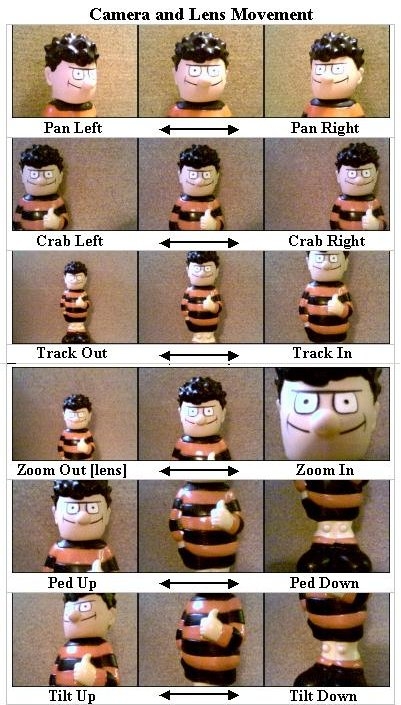
Camera and lens movement


These are the camera and lens movement we have learnt in class. All of these above is used when people are using the camera. A lot of the positions have names that is named after it as you can see above.

Friday, 30 November 2012

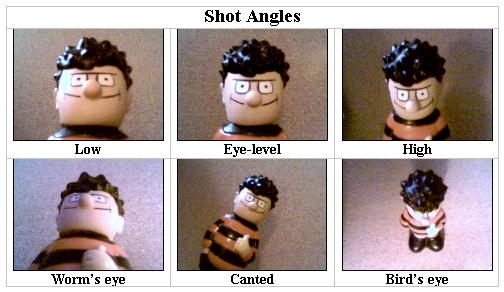
shot sizes and shot angles


Extreme long shot(XLS)
long shot:(LS)
Mid long shot:(MLS)
Mid shot:(MS)
Mid close up:(MSU)
Close up:(CU)
Big close up:(BCU)
Extreme close up:(XCU)
                                      

Thursday, 29 November 2012

Thriller conventions

Conventions

The aim of a thriller is to make the audience feel anxious and keep them alert. Central to the plot could be Justice vs Injustice, some of which could have blurred line of good and bad, these could have red herrings,enigma,cliff hangers or a plot twist.It feels like your on the edge of your seat when your watching a thriller it builds up tension and suspense  In a thriller they also have a range of emotions such as excitement, being anxious and shocked etc. 

Sub genres

  • In crime thriller there could be revenge and kidnapping.
  • In mystery thriller there could be investigations could take place.
  • In Psychological there could be mind games,horror, stalking and death traps.
  • In political there could be national or international political scenarios.


The moods that is included in a thriller could be murder, menace, mystery and paranoia.Thrillers usually make the world/place look like it is dark and dangerous. Its usually a character on a mission where trying to escape is impossible.


Thriller Conventions can consist of these listed below:

  • Tension
  • Fast Editing
  • Red Herring
  • Cliffhangers
  • Dilemma
  • Suspense
And many more ...


Wednesday, 28 November 2012

Lighting


In a studio when they are filming it is usually form three different light source such as:

Key lighting: Brightest, main light on subject. It is usually the most influential.
Back lighting: counters the key light, making the character or object look more rounded.
Filler lighting: Softens the harsh key light, eliminates harsh shadows and there may be more than one filler light.

These source of lighting can be in different positions which makes different affect:

  • Under lighting: This is where the lighting is coming from underneath this creates a distorting effect of the character/object.This kind of lighting is used in thrillers and horror films.
  • Top lighting: This lighting comes from above which gives a flattering look and highlights the features of the character. If it was used in a film with someone glamorous in it then this kind of lighting will be used.
  • Back lighting: this light source comes from behind the subject.If no lighting is used this lighting also creates silhouettes.


Low Key lighting: This is created by using the key light and back light.This will create a contrast of light and dark areas on the screen as very deep, distinct shadows are formed. This is also known as chiaroscuro, which in Italian it means light.


High Key lighting: This affect is created by using lots of filler light, the lighting to our eyes makes the image look realistic and normal. This reduces the light in the image and makes the character/object bright and happy.

Tuesday, 27 November 2012

Editing and continuity editing

Continuity editing this refer to arranging the sequence of shots to suggest a progression of events.If they use the same shot the editor can come up with different types of scenarios.
For example:


  •  A man glancing up in surprise 
  • Another man pulling a gun and firing it towards the camera
In the first order it looks like the first man has been shot. But if you reverse the order the an is watching a shooting take place.


Editing is the process of looking at all of the footage shot during the making of a film and programs and placing it in he desired order and joining it together.
There are two key areas to concentrate on with editing:

Speed of editing: how long does each shot last.
Style of lighting: How each shot is joined to the next.

Dissolve:


  • Merge to a different scene
  • Artificial web to real web
  • Fading one shot of screen while another shot is fading out.
  • See both shots-used:connection between two characters, fades places or object.
  • A gradual darkening or lightning black/white.
  • One shot fade until only a black or white screen can be seen.
  • Indicate in the end of a particular section within the narrator.
  • Can show the passing of time.


Straight Cut:


  • most common and invisible form of transition.
  • one shot instantaneously to the next without attracting the audiences attention.
  • straight cuts help retain reality. They don't break viewers suspension of disbelief.

Wipes:


  • One image is pushed off the screen by another.
  • Image can be pushed left or right.
  • Is more common for image to be pushed to left more consistence. 
Jump Cut:
Digital Video Editing: The Grammar of Editing

  • A jump cut is where the audiences attention is brought into focus on something very suddenly.
  • This occurs by breaking the continually editing,this is known as discontinuity.
  • It appears as a section of the film has been removed. A moment when the film is stopped.


Monday, 26 November 2012

Unknown

Unknown Poster


The film that we have been watching is called Unknown (2011), which is a action film and mysterious. This is a different type of film we have watched in class that contain a lot of violent and horrifying scenes.

While his wife checks in at a hotel he goes grabs a car to return to the airport for his briefcase, which is left at the curb. They both get into the car they both have a car crash at the beginning of the film which puts him into a coma. From which he awakes four days later, only to discover that his identity has been taken away from him leaving him with no one. He goes to the hotel, his wife refuses to recognize him as she's with another man who is claiming his identity.

As he wants his wife back he tries getting help from a nurse, the cab driver,a retired agent and an academic friend he tries to unravel what's been going on for the four days his been in a coma.

As the film goes by he starts to capture images in his head and then starts to remember what has been happening. 

He knows that he is being tricked in someone else taken his identity and tries getting it back. As he gets his suitcase he remembers the lock code and is give to him.

Sunday, 25 November 2012

Chuck Jones and 'The rules'


Chuck Jones is a animated character who works at Warner Brothers for decades making short movies. Starring bugs bunny, Daffy Duck and the company. He also made the road runners cartoons and from the first episode, an elaborate set of rules emerged.

The Rules


1. The Road Runner cannot harm the Coyote except by going "meep, meep."
2. No outside force can harm the Coyote -- only his own ineptitude or the failure of Acme products. Trains and trucks were the exception from time to time.
3. The Coyote could stop anytime -- if he were not a fanatic.
4. No dialogue ever, except "meep, meep" and yowling in pain.
5. The Road Runner must stay on the road -- for no other reason than that he's a roadrunner.
6. All action must be confined to the natural environment of the two characters -- the southwest American desert.
7. All tools, weapons, or mechanical conveniences must be obtained from the Acme Corporation.
8. Whenever possible, make gravity the Coyote's greatest enemy.
9. The Coyote is always more humiliated than harmed by his failures.
10. The audience's sympathy must remain with the Coyote.
11. The Coyote is not allowed to catch or eat the Road Runner.